
Remote machine monitoring for the machines you have already sold.
MIE is remote machine monitoring built for OEMs and machine builders. It was built multi-tenant from the start. Run remote service for every customer from one place, and give each customer their own view of their machines.
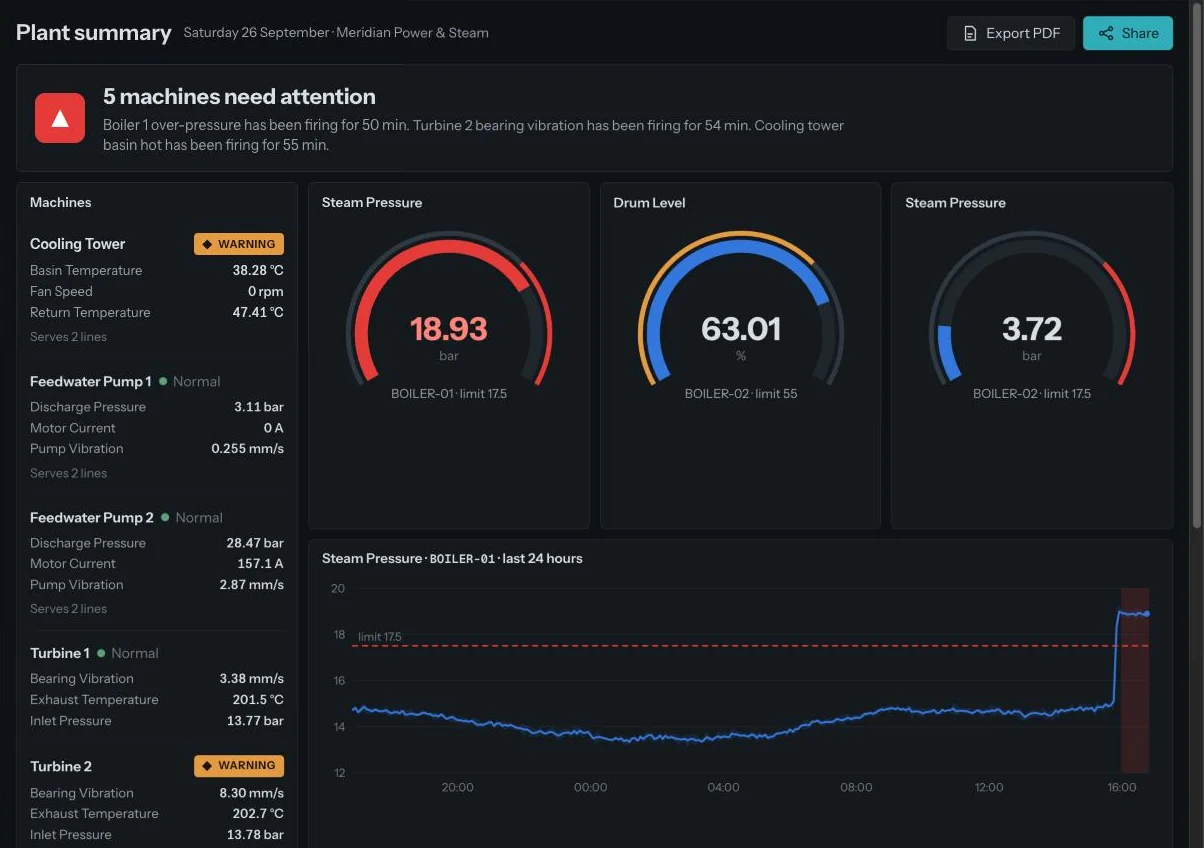
Companies, processes, machines.
Remote monitoring for OEMs only works if every customer's data stays apart. In MIE, each customer is its own company, with its own users. Your service team sees across all of them. Each customer sees only their own machines.
Fewer site visits, more proof of value.
Escalation on Slack, WhatsApp and webhook, climbing until someone acknowledges, per customer.
A page per customer showing status, alerts handled and trends. Export as PDF or share a link.
Put a live view of each customer's machines inside your own portal.
"Which customer sites had a compressor stop this week?" answered in plain English.
Know when a gateway at a customer site starts sending bad or unknown data.
On the OEM plan, for teams that need enterprise controls.
From the first customer site to the whole fleet.
Setting up an equipment remote monitoring system should not need a project team at every customer.
- Listen
A call about how your service team works today: which machines you sell, what goes wrong in the field, and what customers ask you to prove.
- Map
Each customer becomes a company. Under it go its processes and every unit you shipped, with its tags, units and limits. Define a limit once for a tag type, such as boiler drum level, and it applies to every machine of that type.
- Connect
We set up the gateway at the customer site over HTTPS, MQTT, OPC-UA or Modbus. Readings start flowing and get checked. Only known machines and tags get in.
- Set the rules
Alert rules with priorities and durations, and escalation tiers: your service engineer first, then a senior engineer, then the service head. One tap on acknowledge stops the climb.
- Prove it
First alerts reach the right people, first answers from Ask, first client summary sent to the customer. We review them with you, then add the next site.
Works with the controllers already in your machines.
No new sensors or hardware. MIE takes the readings your machines already have. Not sure which protocol suits your machines? Read OPC-UA vs MQTT vs Modbus.
- Data in. HTTPS, MQTT, OPC-UA and Modbus, from the PLC, gateway, historian or edge device at the customer site.
- Send from your own systems. A REST API takes readings over HTTPS, with a key per source.
- Alerts out. Slack, WhatsApp and webhook, so alerts land where your service team already works.
- Views out. Embeddable dashboards that sit inside your own portal, under your brand.
- Business systems. SAP, Oracle, Microsoft Dynamics, SQL Server, PostgreSQL and Excel.
- Alongside SCADA, not instead of it. The customer's control system keeps running the machine. MIE watches the data, escalates problems and answers questions.
Forty customer sites, one service team.
Without machine builder IoT monitoring, a service team learns how machines in the field are doing through site visits and phone calls. Here is what changes.
- Finding out a machine has a problem. Before: the customer calls, often after the stop. With MIE: an alert reaches your on-call engineer on WhatsApp within minutes, and climbs until someone takes it.
- Checking how the fleet is doing. Before: a round of calls and site visits. With MIE: every site in one view, filtered by customer, process or machine.
- Answering "what happened last week?" Before: an export, a spreadsheet and half a morning. With MIE: ask in plain English and get the number, with the query MIE ran shown underneath.
- Proving the value of a service contract. Before: a report put together by hand. With MIE: a monthly client summary of uptime, alerts handled and readings, ready to send as a PDF or a link.
- Trusting the data. Before: bad readings quietly skew the charts. With MIE: unknown machines and tags are refused and logged with the reason.
A week at a machine builder using MIE.
This is an illustrative example, not a customer story. Picture a builder of compressors and boilers with machines at many customer sites.
- Monday, 3 a.m.
A boiler at one customer site goes over pressure. WhatsApp reaches the on-call service engineer. Nobody answers in 10 minutes, so it goes to the senior engineer, who acknowledges it. Escalation stops, and MIE records who took it.
- Tuesday
The service head asks, "Which customer sites had a compressor stop this week?" MIE answers from live data and shows its working.
- Wednesday
After a PLC change at another site, the gateway starts sending a tag MIE does not know. The rejected-data log shows it with the reason. The team defines the tag in one step and readings flow in again.
- Month end
Each customer gets a client summary: machine status, alerts handled and trends. Some read it as a PDF. Others see the same view live, embedded in the builder's own customer portal.
Built for the people who look after machines in the field.
See which sites need attention first, without waiting for the phone to ring.
Timed tiers make sure the right engineer hears first, and one tap shows the rest it is handled.
Each customer has their own users and data, a summary each month, and a live view in your portal.
The OEM plan, priced on your fleet.
MIE is live at client plants today. The OEM plan is for machine builders serving many customer sites, with volume pricing worked out on the size of your fleet. Talk to us for a quote, or compare plans on the MIE pricing section.
- Multi-company tenancy. One company per customer, with separate data and users.
- Embeddable dashboards and per-customer summary reports. Sent and shown under your brand.
- SSO, audit log and dedicated onboarding. For teams that need enterprise controls.
- Security. Data is encrypted in transit and at rest, and each client is isolated. Read more on our security page.
- Coming next. A "Likely next" panel in every client summary, from predictive maintenance, and custom dashboards built by describing them. Both are on the roadmap, not live yet. MIE Carbon, for emissions, is in development.
Common questions.
What is remote machine monitoring?
Can each customer see only their own machines?
Can we use our own branding?
How is OEM pricing worked out?
Do our customers need new sensors or hardware?
Which protocols does the remote monitoring system support?
Does MIE replace the customer's SCADA or historian?
Is our customers' data secure?
Ask the demo plant your own question.
We'll walk you through MIE on a live plant in 30 minutes.
Or call +91 98288 93692 · +91 88519 85656 · info@thinklytixai.com